
Introduction
Conference planning has that predictable loop. Agenda, speakers, signage, meals, A/V. Someone checks the room sets. Someone panics about name badges. Then transportation slides in late and gets treated like “we’ll run a shuttle” or “people can Uber.”
Except transportation is where accessibility quietly breaks.
If an attendee can’t get from their hotel to check-in without guessing, waiting in a messy curb line, or getting dropped at the wrong door, the event stops feeling organized before they even see your branding wall.
The fix is rarely complicated. It is mostly about being deliberate. Plan for ambulatory support and wheelchair-accessible rides as two different things. Respect peak arrival windows. Make the last 50 meters as thought-through as the first 5 miles. Do that, and arrivals feel calm instead of stressful, which helps the rest of the day go better for everyone.
What follows is the stuff that tends to get missed: intake that actually works, the full route (not just “hotel to venue”), curbside flow that survives a surge, vendor questions that force real answers, and attendee instructions that cut down on day-of panic.
What “accessible transportation” means for events
This isn’t one bucket.
Some attendees are ambulatory, but distance is the problem. Stairs, long corridors, a steep ramp, standing in a crowd while traffic crawls. They can walk, until they can’t. They may need a closer pickup point, a slower pace, or extra time getting in and out of a vehicle.
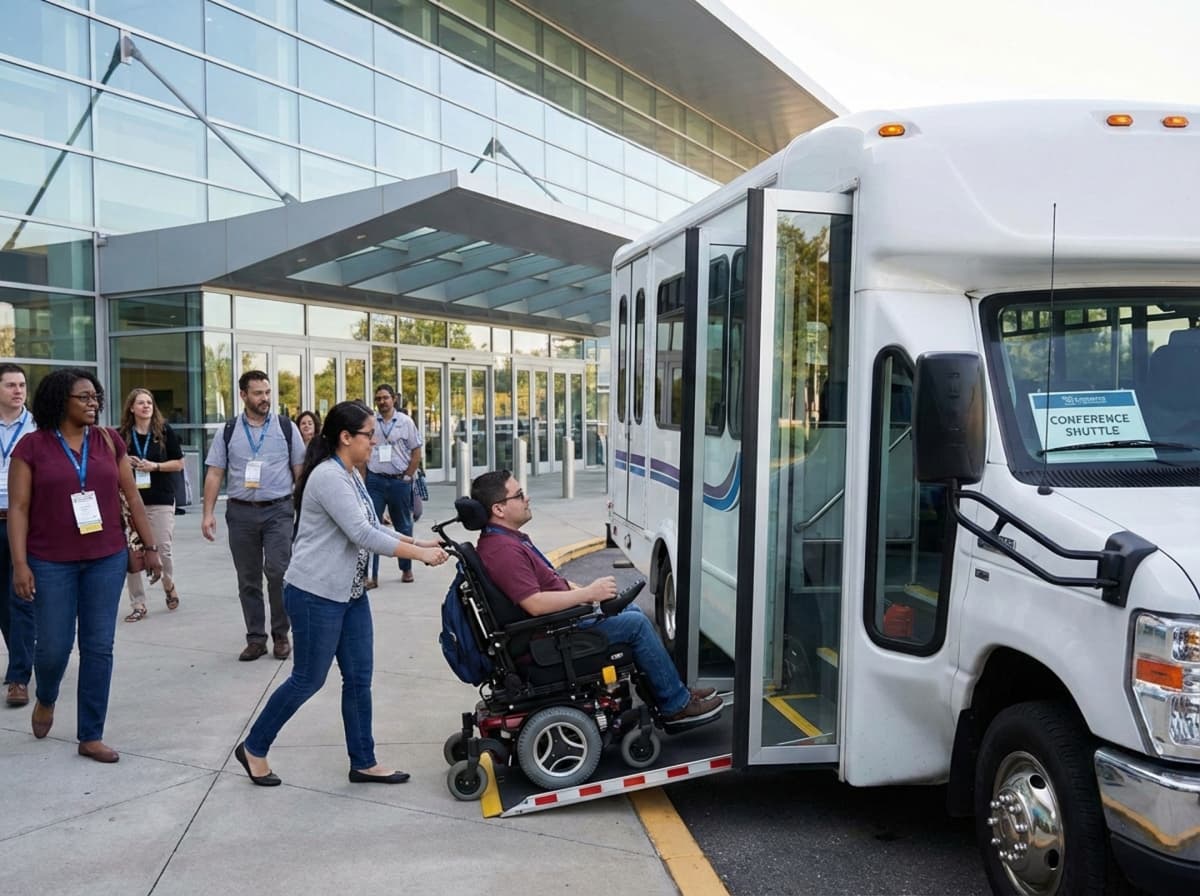
Wheelchair users need a vehicle that can actually take them safely. Ramp or lift, proper securement, a drop-off that doesn’t dump them onto an awkward curb. And then a route they can follow without hunting for the right door while everyone else floods the entrance.
This is where the classic organizer phrase goes wrong: “the venue is accessible.”
A venue can be ADA-compliant and still be a pain in real life. The trip is the thing. Pickup to badge pickup, with no mystery detours and no “wait, where do I go now?”
Collect attendee needs the right way (simple, respectful, useful)
Most failures happen because the info shows up too late.
Ask early, keep it short, and don’t drift into medical territory. Ops doesn’t need diagnoses. Ops needs enough detail to schedule a ride that works.
Put the questions in three places: registration form, confirmation email, reminder email 48 to 72 hours out.
Keep the fields practical:
- Do you need transportation support to/from the venue?
- ambulatory support
- wheelchair-accessible vehicle
- pickup location (hotel/address)
- pickup notes (which entrance, best meeting point, short-walk preference, anything that helps the driver find them fast)
Then do the unglamorous internal part:
- one person owns requests (a shared inbox sounds fair, then nobody owns it)
- a clear cutoff for requests
- one “source of truth” for the final schedule (run-of-show + dispatch sheet + whatever your staff actually uses day-of)
Clean intake makes vendor coordination less chaotic. It also keeps you from inventing solutions at 7:30 AM while a line forms.
Map the full access route (hotel lobby to badge pickup)
A lot of plans stop at “hotel to venue.” That’s not where problems live.
Map the whole path: hotel lobby -> curb -> vehicle -> venue curb -> entrance -> registration -> seating.
Go look at it, or have someone on your team do it and document it. Check curb cuts and ramps (plus whether they’re likely to be blocked during rush periods), automatic doors and elevator access, the distance from drop-off to the best accessible entrance, and the indoor distance from entrance to registration, then to the main rooms.
Sometimes the “accessible entrance” exists, but it’s tucked away and nobody can find it without wandering. Pick the entrance you can defend operationally, then stick to it. Same entrance in driver notes, attendee msgs, staff briefing, signage. Once you start mixing doors, you get confusion fast.
Build a curbside plan that survives peak arrival times
Peak arrivals are where nice plans get crushed.
Accessible loading takes longer. It needs space. It doesn’t work well when ride-share drivers are double-parking and people are pouring across the curb.
Split your curbside flow:
- general arrivals (high volume, fast turnover)
- accessible arrivals (slower, needs clear space)
Stuff that helps in real life:
- a dedicated accessible drop-off point, or timed arrival windows
- cones/signage plus a staffer in place before the first wave
- one clearly labeled on-site transport help contact who actually answers
Buffers matter. Wheelchair loading and securement takes time. If you schedule rides back-to-back with zero slack, the whole chain collapses the first time someone is 8 minutes late.
Also: protect the lift/ramp zone from foot traffic. If the accessible drop-off gets swallowed by the general curb mess, it’s “accessible” on paper and useless at the moment it matters.
Choose transportation partners and ask better questions
“Wheelchair friendly” is marketing language. It doesn’t tell you what vehicle shows up.
Push for specifics:
- Can you provide wheelchair-accessible vehicles (ramp/lift) reliably during our actual peak windows?
- What happens when the schedule changes day-of? Who dispatches, and how do we reach them?
- How do you build in time for loading and securement?
- What are your policies for no-shows, late pickups, reroutes?
- Can you support ambulatory rides with door-to-door expectations if needed?
You’re not buying a van. You’re buying day-of reliability.
If you’re planning in a city like Miami, organizers sometimes keep services like Call The Care in mind for both ambulatory support and wheelchair-accessible rides, since those trips tend to need tighter scheduling than standard shuttles.
Make instructions easy for attendees (clarity beats “nice wording”)
Transportation works when attendees feel sure about what happens next.
Vague instructions cause the flood of “where are you?” texts. They also create stress for the people who already have to plan their day carefully.
Give specifics: pickup time window, exact pickup point (entrance name, lobby spot, landmark), exact drop-off point (venue entrance name that matches what staff are saying), what to do if the vehicle is late, and a contact method that is staffed with hours listed.
Copy-ready examples:
- Wheelchair-accessible pickup window: 7:40 to 7:55 AM
- Meet at: Hotel Lobby, North Entrance
- Venue drop-off: Conference Center, Main Accessible Entrance, Door A
- If you don’t see your vehicle by 7:55 AM, call/text the transport desk at
[number]
When your msg is specific, attendees relax. Staff also stops getting pulled into frantic hallway troubleshooting.
Staff roles and a simple escalation plan
Even with prep, something will go sideways. The difference is whether your team has a plan or just good intentions.
Assign roles:
- transportation lead: owns the vendor relationship and the schedule
- curb coordinator: controls the drop-off zone and keeps accessible space clear
- registration point person: handles attendee questions and relays updates
Keep the escalation ladder simple and written down:
- late pickup -> check dispatch -> update attendee -> activate backup
- wrong vehicle type -> swap request -> reshuffle buffers
- blocked entrance/curb zone -> move to the secondary accessible entrance and tell everyone fast
Common mistakes organizers make
These show up over and over:
- asking about accessibility needs too late, or skipping the question entirely
- scheduling rides but forgetting the curb-to-registration route
- no buffer for loading/securement
- one curb zone for everybody, so lift deployment becomes a bottleneck
- instructions like “meet outside the hotel”
Every one of these creates uncertainty. Uncertainty is what turns transportation into the part people remember for the wrong reasons.
Wrap-up
Accessible transportation isn’t a bonus feature you tack on after the agenda is pretty. It’s part of the experience, right at the front door of the day.
Clean intake, route mapping that includes the last stretch, a curb plan built for surges, vendors who can answer real questions, and instructions that leave no guessing. Get those right and the morning feels steady. Get them wrong and you’re doing damage control before the keynote even starts.